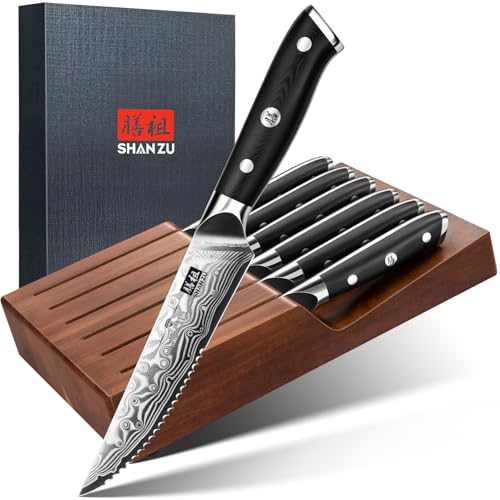
Japanese Knife Sets
Best Prices & Latest Japanese Knife Sets
Our product rankings are based on analysis of thousands of customer reviews, brand reputation, pricing trends, and popularity data. They represent our honest opinion and are intended as a helpful starting point for your research. Some links on this site are affiliate links — if you buy through them, we may earn a small commission at no extra cost to you. This helps us keep the site free and up to date.

This 7-inch Damascus steel knife features S301 powdered steel construction with 64 HRC hardness for exceptional cutting performance. The blade undergoes deep vacuum cooling and traditional Japanese hand forging to create a unique peacock pattern.
The full tang design extends through the entire Pakkawood handle, creating perfect balance and reducing user fatigue. Heat-treated handle construction resists wear and deformation during daily kitchen tasks.
Each Mitsumoto Sakari Japanese kitchen knife arrives in an elegant sandalwood presentation box, making it perfect for gifting. The flower rivet adds both structural integrity and aesthetic appeal to the handle design.
S301 powdered steel offers superior performance through its manufacturing process. The powder metallurgy creates more even carbide distribution throughout the steel, resulting in consistent hardness across the entire blade. The vanadium content increases wear resistance, meaning the blade stays sharp longer and requires less frequent sharpening compared to conventional stainless steel kitchen knives.
Hand wash the knife immediately after use with warm soapy water and dry thoroughly to prevent water spots on the Damascus pattern. Avoid dishwashers as the harsh detergents and high temperatures can damage the blade finish. Store the knife in the provided sandalwood box or use a knife block to protect the edge. Sharpen using whetstones rather than pull-through sharpeners to maintain the blade geometry.
The 64 HRC (Rockwell Hardness Scale) rating indicates this blade is significantly harder than most kitchen knives, which typically range from 56-58 HRC. This higher hardness allows the blade to hold a sharper edge for longer periods, making it excellent for precision cutting tasks. However, harder steel requires more careful handling to avoid chipping and should not be used on frozen foods or bones.
Yes, the full tang design provides several advantages that justify the additional weight. The steel extending through the entire handle creates better balance, reducing hand fatigue during extended use. This construction also provides superior durability and control, especially important for professional kitchen work. The balanced weight distribution makes the knife feel more natural and responsive during cutting motions.
This knife is designed for vegetable preparation and general kitchen cutting tasks rather than heavy-duty chopping. The high hardness (64 HRC) makes the blade excellent for slicing and dicing but more susceptible to chipping if used on bones or frozen foods. For bone chopping, use a dedicated cleaver or butcher's knife to preserve this blade's sharp edge and prevent damage.
Pakkawood combines the natural feel of wood with enhanced durability through resin impregnation. Unlike solid wood handles, Pakkawood resists moisture absorption, preventing warping and cracking over time. The heat treatment process further improves stability compared to untreated wood. It provides better grip than plastic handles whilst being more hygienic and durable than traditional wood handles.
The 7-inch blade length is ideal for most vegetable preparation tasks including dicing onions, slicing tomatoes and chopping herbs. This size provides good knuckle clearance for rock chopping techniques whilst remaining manoeuvrable for detailed work. It's perfect for julienne cuts, brunoise dicing and general prep work but may be too small for large vegetables like whole cabbages or watermelons.
The Damascus pattern is primarily aesthetic, created by the traditional hand forging process rather than affecting cutting performance directly. However, the forging technique that creates this pattern does improve the steel's structure by refining the grain and reducing stress points. Each knife's unique peacock pattern is a byproduct of the quality manufacturing process rather than just decorative etching.
| Brand | Mitsumoto Sakari |
| Model Number | MS-1661-G-IT |
| Blade Length | 7 inches |
| Overall Dimensions | 29.1 x 2.3 x 5.5 cm |
| Weight | 230g |
| Steel Type | S301 Powdered Steel |
| Hardness Rating | 64 HRC |
| Handle Material | Pakkawood |
| Handle Construction | Full Tang |
| Blade Pattern | Damascus Peacock Pattern |
| Manufacturing Process | Hand Forged |
| Steel Treatment | Deep Vacuum Cooling |
| Handle Treatment | Heat Treated |
| Rivet Type | Flower Rivet |
| Packaging | Sandalwood Box |
| Knife Type | Vegetable Knife |
| Edge Type | Single Bevel |
| Country of Origin | Japan |
| Age Verification Required | Yes (18+) |
| Care Instructions | Hand Wash Only |
| Blade Finish | Damascus Pattern |
| Handle Colour | Natural Wood |
| Box Material | Sandalwood |
| Suitable For | Professional and Home Use |
| Maintenance Level | High |